

Ride Along on the Road to RootsTech! 🚙💨
For the third year in a row, Projectkin & MissionGenealogy will host a “Ride Along” during RootsTech. We’ll share the show-going experience onsite and online, this time routed over Skybridges.

Cruise the Salt Palace with Friends
If you’re excited about the annual FamilySearch RootsTech conference, come on down! Once again, Projectkin and my sister publication MissionGenealogy will host a “Ride Along” during (and maybe even a little before) the conference in Salt Lake City, UT. The idea is to create a way for us to participate in the show as a community (on-site and remote). It’s like jumping on a bus together; it’s just that some of us are in bunny slippers 🐰🐰.
In 2024, Projectkin hosted a series of talks, and last year we added MissionGenealogy and got serious…

Last year’s dedicated team of collaborators on site included Robin Stewart, DearMYRTLE, Lori Olson White, Kyla Bayang, and Tami Osmer Mize. In addition to the onsite team, our livestreaming guests included Kathy Stone, Maureen Taylor, Jennifer Jones, Emma - Journeys into Genealogy, and Bill Moore.
Livestreaming on Substack was new to all of us then. It offered a palpable sense of being together for the show. Part of the magic was the sense that whether onsite or offsite, we were doing this together.1
For 2026, we’ll build on that and expand it beyond Substack itself.
RootsTech 2026: An Open Ride Along
A new year creates new opportunities for innovation, improvement, and creativity. So, we’ll start with the original idea of live events, and add…
Links and bridges to make the “Ride Along” more open. Why limit it to Substack account holders?
Multiple channels: While we’ll still do Substack livestreams, we can also use YouTube or any other publicly accessible web-based platform for audio, video, or written, or combined posts.
Posts and discussions can be linked or embedded on any long-form or media-based platform.
Consistent with my “Skybridges” post from earlier this year, the idea is to create a more open space where ALL of us, as family historians and genealogists, can meet and mingle, share what we’ve learned, and leverage what others discover or create.
The idea is to create a positive space to help increase each other’s visibility while leveraging existing platforms to do what they do best.2

RootsTech 2026 Ideas:
So far, we’ve identified five active components of this Ride Along. Here’s a preview of what I have in mind so far:
Your feedback can help me figure out what to replace, expand on, or improve. Here’s what I’m thinking. What do YOU think?
🎬 Livestreamed Conversations
As in 2024 and 2025, I plan to recruit speakers to join me in Livestream sessions. I’m not sure yet how many each day. From past experience, I know to avoid more than one daily email to my subscriber base. Last year, I found that combining multiple recordings into a single post worked pretty well, though it was time-consuming.3
Personally, I’m happy to switch to YouTube for livestreams, so Substack is no longer a requirement if my guests prefer. Platforms are like languages; it’s easy to switch to a common denominator. I also recently discovered that Substack now lets anyone view a livestream link; you no longer have to be a subscriber.4 👀
Do you already have a plan for RootsTech posts for your readership that you’d like me to include? Let me know. I’d love to get a sense of who is interested.
🚩 Special RootsTech Posts
With a little embedding magic, I’ve planned to create a page (or pages) of embedded posts, videos, and more.
I’d like it to be a little like a community, special-occasion, newspaper.
The idea is to share meaningful insights about what’s ahead, what you’ve just seen, or what you think others should see. I envision including compendium posts, roundups, and videos. I see no reason these need to be limited to any platform, so I’ll welcome posts from any long-form platform (see Notes below).
I’ll be more than happy to share relevant posts as long as they’re accessible without a login (WordPress, for example, but not Facebook). I’ll not accept commercial posts or product pitches, and long-form helps me manage scale, but I’d like to be open-minded beyond that.
I’d love your thoughts on this so I can anticipate questions and problems. I’ll focus in the meantime on automation and scaling so I can physically handle it.
These will all be posts on your own site, I’ll get you a form where you can submit your post so I can add it to the page. A few suggestions I’ve heard so far for posts that would be helpful to others include:
Daily Summary, Roundup, and Compedium Posts:
Those posts highlight what YOU think is interesting. With your permission, I’ll embed your post to increase your visibility. It’ll help us find it!
⮕ I’m thinking about including a few daily “columns.” Interested? Let me know (email or Substack DM @Projectkin)
Livestream feeds/recordings: Substack, YouTube, TikTok?
If you’re taking the time to run a livestream, that’s awesome. Let me help get your programs some visibility.
⮕ As with last year, it’s easy to embed recordings, and your posts can help to get the word out about timing.
Posts about what happened at the show:
Tell us insights, experiences, and what you enjoyed. Have a special strategy for getting through the Expo Hall or for managing sessions? Let us know.
⮕ I envision a form that nudges me to include your posts, or a dedicated channel. Tell me now what you’re thinking. (Again, email or Substack DM @Projectkin)
🐰🐰 🍿 Viewing Parties for Online Classes & More
We’re already seeing a lot of excitement about the upcoming classes. The schedule, though frequently changing, already reflects the diversity and depth of previous years. Take a moment to see what’s been posted so far:
In case you missed it, Bill Moore and Kyla Bayang have already started collaborations. On Friday, January 8th, shortly after the schedule was posted, they shared a livestream talking about the upcoming schedule. (See the full conversation at billmooreny.substack.com/p/live-with-bill-moore.)
I have a few ideas for sharing class suggestions and playlists. Lists of favorites would be easy in a list view.
Someone suggested “viewing parties,” which sounds like fun, though keep in mind, it would be limited to the online classes.
“The kids” do this kind of thing with movies and whatnot. Have a best-practice to suggest? There are several software solutions on the market. It’s not my expertise, but if you’re on it, let me help!
My thinking is that people could suggest classes they’re willing to host parties for, and provide a contact address. You’d be on your own to set it up, but my page can share the interest.
🗓️ Schedules & Time Zones
I can appreciate that for many people, event times synchronized to North American Mountain Standard Time (MST) can be hard to calculate on the fly. I’ve used an external tool for years, so let me help. I have already added major time windows to the calendar (see them here) and added an international clock widget to my Event and RootsTech pages.
Are there other ways I can help make clock calculations easier?5
🕳️🐇💨 Relatives? Maybe YOU Are MY Cousin!
Each year, the team at RootsTech releases a special show configuration for “Relatives at Rootstech” that connects their show registrant database to the main FamilySearch database. The interface shows how you are connected to other RootsTech attendees.
Though I was a doubter at first, by last year, I was all-in on this tool, which helped me discover tens of thousands of connections and cousins.

The problem is that Relatives at RootsTech isn’t open until a few weeks before the show starts. Based on a terrific insight from Kyla, I discovered that the FamilySearch “Famous People” listing is linked to the FamilySearch database and is accessible year-round at RelativeFinder.org, so we CAN get started now! Here’s their intro video:
To find each other, I’ve created a private “Ride Along” group called “Projectkin.” To get started, have your FamilySearch ID ready, then use FamilySearch to log in to RelativeFinder.org. Now…
Tap on Groups in the top navigation bar, pull it down to select Join. In the resulting search box, enter Projectkin (yes, that’s one word 😉).
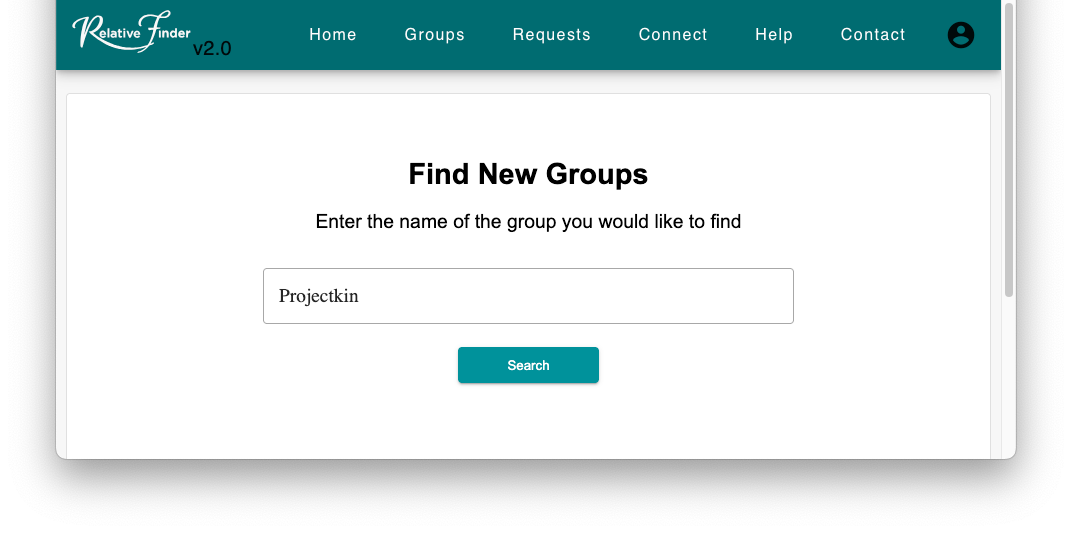
Once you’re in, you can see all the ways in which you are connected to others in the community. It’s honestly a lot of fun. Once you identify common ancestors, you can share what you know with your newly discovered, equally motivated cousins.6
A caution though: It’s a tad buggy and convoluted sometimes. Here’s a clip from my walk-through with Crystal Lorimor. A hat-tip to Crystal for her patience.
As you’ll quickly discover, the more of your known tree is documented in FamilySearch, the better you’re able to use these tools to find and connect with cousins you may not already know. (FamilySearch has a not-so-secret plan to hook you on the service, 😉.)
Note: Though I believe they’re working hard to broaden the reach, I think the majority of FamilySearch subscribers are currently in the US and Canada, limiting the tool's global reach. Don’t be discouraged by low numbers at first.

Why Am I Doing This?
That’s always a good question. I’m sponsoring this RootsTech Ride Along as an individual because I know it can be useful. As Projectkin, I’m all about encouraging families get their stories told. As MissionGenealogy, I’m working hard to create a community clubhouse on Substack where we can connect year-round. From your enthusiasm last year, I could see that many of you felt the same way.
This kind of engagement is the best possible way to introduce who we are and what we’re doing to a large audience of highly motivated genealogists. We all want to share this joy with friends and family. Coincidentally, it also benefits the conference hosts, FamilySearch. I’m not looking for any sponsorship7, but their alignment helps since they ultimately control online access to the conference.
I’m not going to Utah again this year, so I’ll be joining the show from the cheapseats here in Berkeley, California. My North American PST time zone is conveniently positioned between the American continent and Europe to my east, and the Pacific to my west. Last year, when we vastly expanded the scope of the Ride Along, the feedback was terrific. This year, with a few input forms and streamlined tools,8 I think we can expand beyond Substack without a huge lift. We’ll find out!
To be sure, I’ll rely on many of you as collaborators and all of you for your support and engagement. I have come up with a few rules to make our lives a little easier during the show. I know efficiency is key to scale.

Notes: A Few Rules to Make This Work
Since this is all new, I want to avoid misunderstandings. Our shared posts should reflect our excitement about the show and topics that might interest other members of the community. There will be no fees exchanged, no product placements, none of that sort of thing.
1. I Reserve the Right to Decline to Include Posts
Your posts shouldn’t be product pitches, include affiliate links, or other forms of placed media. No judgment, I will simply decline to post those.
By using my Projectkin.org domain, I’ll be taking responsibility for linked posts, so I reserve the right not to embed or otherwise reference some material that feels out of scope, political, or otherwise inappropriate.
If I’ve let something through that you feel is inappropriate, feel free to let me know.
2. Posts Should be Directly Relevant to RootsTech
On any given day, there’s a lot of interest in genealogy news, new features, and all sorts of topics.9 During the conference, influencers, bloggers, and an entire press team will cover vendor announcements, special deals, and offers. You don’t need me to reproduce those announcements.
I’m totally fine with compedia and summaries that include references to show specials and that sort of thing.10
I will be happy to share posts you’ve written about how a connection at the show transformed your research or something like that.
I’m interested in stories about you, your research, and discoveries, not product pitches.
3. Posts Should be from Established Genealogy Community Members
I’m not sure yet how I’ll police this, but my goal is to help connect community members who are genuinely interested in genealogy and family history. This will necessarily be subjective, but I may ask for links to validate credibility.
4. Event Announcements & News Posts Belong Elsewhere
I’ve tried hard to keep a good sense of what I can do well and what others do better. I want to “stay in my lane,” as they say.
For scheduling the many special programs during RootsTech, I will use — and strongly recommend — ConferenceKeeper.org. I’m in awe of Tami Mize’s can’t-miss weekly mailing. The same goes for regular news-feeds at newsletters like Randy Seaver of Genea-Musings, DearMYRTLE’s Village Square and Linda Stufflebean’s Empty Branches on the Family Tree, and her Friday Finds list.
5. Posts Should be of High Quality and Your Own Work
I’d expect every post to be clearly written and your own work. I’m not interested in automated AI-generated copy or any form of plagiarism. I can accept a few exceptions to AI-generated content, if they’re contextualized as examples, for instance, or just part of automation.
I will, however, insist on your own work, perspective, and most of all, stories. The whole point is to connect at a human level about our shared interest in our family stories.
Have thoughts for me on this point? I’d love to hear them.

Think you already have a post for me, or have been cooking something up for the show? Bring it on! Let’s talk.
Right now, I just wanted to let you know this is happening and to solicit your feedback. As I get more ideas, I’m sure I’ll modify some details of the plan and expand others.
Title Image: Composite showing a VW Bus (from makamuki0 on Pixabay) in front of a 1939 Road map of the US from the McCauley Map Case Company (photo from the David Rumsey Map Collection).
You can learn more about last year’s approach and see the recordings on Projectkin.org/rootstech.
We used to be able to do this by combining blogging platforms, a few common social media tools, and hashtags like #RootsTech2026. However, the implosion of platforms like X, Instagram, and Facebook has made that difficult at best.
For my guests, however, each appearance creates an opportunity to share the recording with their own subscribers. It also gave each guest the experience to livestream on their own. I’m more than happy to share what I’ve learned. Though it’s not my best work, I created a livestreaming best-practices guide to help my guests know what to expect. It already needs updating to reflect livestreaming from a desktop.
Though a Substack host can configure a livestream to be limited to their paid subscribers, for example, making a stream available to “everyone” also means it can be viewed by followers on Bluesky. I confirmed this with testing in January 2026. Like most things-Substack, it may change.
North America will jump to Daylight Saving time on the Sunday after RootsTech, so fortunately, we don’t have all of those recalculations to worry about ahead of the show.
Keep in mind, of course, that all data is subject to the risks of any public tree. As a rule of thumb, the further back you go, the more likely the data is to be a little “squishy.” So, take the learnings with the appropriate skepticism.
For the record, I would refuse any FamilySearch sponsorship if offered. I don’t accept any sponsorships or affiliations for Projectkin or MissionGenealogy. Consistency may be a hobgoblin of small minds, but it also makes for easy decision-making.
Note that I haven’t created those forms yet, but I plan to. Your feedback on this post will inform the design.
This is personal to me. After more than a decade of pitching a startup, I know how to lean in on earned media. I can respect your goals without compromising why we’re here.
So many great ideas here Barbara. I have a few ideas about posting before and during RootsTech but haven’t made a plan yet. You’ve got me thinking. I’ll be in touch