

Announcing Migration Stories — Paths to Family History Through Community
Wherever we are, our family stories include migrations from familiar places to foreign lands. These journeys have transformed individuals and families, let's explore these stories together!

You’ve seen the lederhosen-to-kilt story about an Ancestry DNA customer in a powerful TV ad. It’s honestly charming. Variations of that story have been running since 2017, as each new DNA customer discovers “who they are.” As family historians and genealogists, we know there’s more to a family story than a pushpin on a map and a tartan. Our ancestors’ journeys are the root of some of the most important cultural traditions passed down to us. This is where our cultural heritage mingles with invented lore and the genetic connections reported out in data. That unique mingling tells “us” who we are and how to celebrate “our” holidays. Capturing these migration journeys is essential to the family narratives we pass down to our descendants.

Here at Projectkin, I’ve been on a mission to encourage ordinary people to capture and share their family stories. After completing the series focused on the American 250th celebrations, I realized that our next initiative should focus on Migration Stories.
In this post, I’ll share the strategy and vision, and explain how this will unfold in September 2026. I’m telling you about it now because I’d love for you to join us. These are your stories you’ll publish in your own publication. Program elements will bring our stories together to see a larger whole, explore the parallels, and encourage each other.
The idea for this series began while working on Projectkin’s Stories250, which ran from August 2025 to June 2026 and featured livestream sessions and regular posts. We celebrated the conclusion of Stories250 with a big party on July 9th, featuring sixteen guest speakers across two hour-long sessions, and a commemorative magazine is in publication as a memento of the experience. I measure the success of that program by the many stories it inspired and the people it touched.

“Migration Stories” developed in livestream conversations with so many of you. In my “All About That Place” livestream with Jude Rhodes in October 2025, we talked about the global connections between so many contributors to both One-Place Studies and the Stories250 already underway. She joined me from her home in Yorkshire, England.
Then, shortly after RootsTech in March, Jennifer Jones my partner in running Projectkin’s Speakers’ Corner series, joined me to share her perspective from Victoria, Australia. A couple of months later, Lisa Maguire help me build out the idea in a conversation about themes in global migrations. As the idea started to take root, Lisa joined me again last week. A few private conversations later, and we have a well-functioning global team to guide Migration Stories! I couldn’t have done this alone.

As a team, we share a fascination with the factors related to migration. Each of us contributes our individual expertise and perspective from distinct parts of the English-speaking world. So far, we’ve decided on the basic mechanics of the program and a launch in September 2026.
As we prepare for that, I want all of you as my subscribers to know what we’re up to, why it matters, and what opportunities are ahead for you!
Migration Stories Collected into “Paths”
To make this work as a community series of programs, we realized that each migration path should be distinct. In that sense, each set of migration stories is characterized by its own “path” or…
Point of origin and destination.
Time window, probably on the scale of a generation or two.
A path may also focus on…
A specific voyage or travel route. Kyla Bayang’s Ship Brooklyn would seem like a great example.
Members of a religious or ethnic diaspora migrating to a particular destination as a result of political, economic, or other stressors.
Forced Migrations as a result of indentured servitude or the enslavement of captives.
Thematic views such as: Picture Brides, Paper Sons, Reverse Migrations, Migrant Labor, and other themes that might not be linked to specific points of origin or destination. These would likely be separate paths.
There are many more variations. The idea is to make these paths general enough to attract storytellers interested in a common theme, but specific enough to be distinct and meaningful. Specifications will help solicit stories that share patterns. Patterns will help us explore even more nuances to the story. To share our discoveries, we’ve anticipated a top layer for the series that would share elements like these1:
A shared website focused on that migration path and optimized for broader visibility to your work in this area.
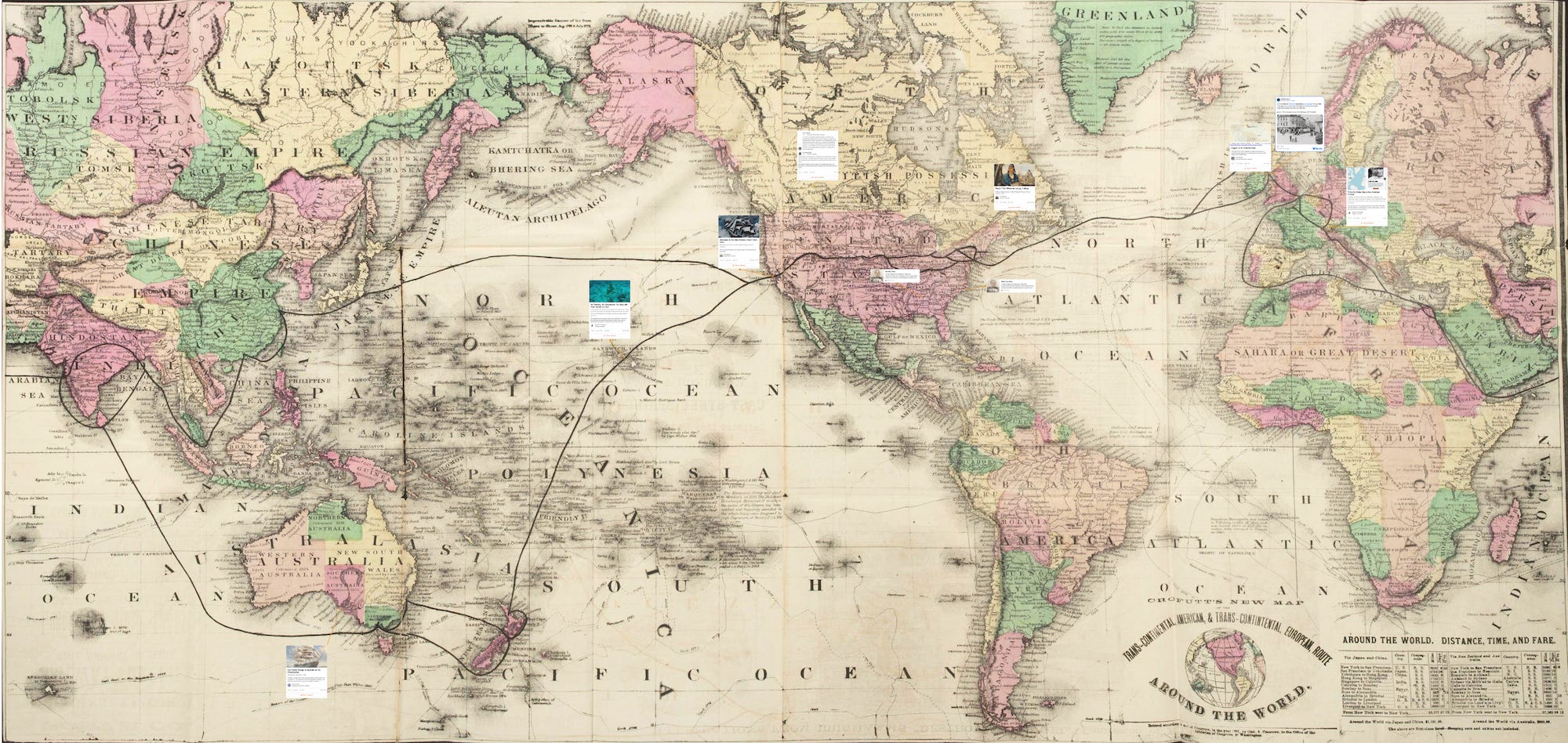
I’ll build this and anticipate a central map room with individual maps designating each migration path; I envision posting articles from each of our contributing authors to that map.2 See the Migration Mystery challenge, Projectkin.org/migration-mysteries, as an example with data points instead of paths.
Development support to create new ways to view and explore these stories.
Special events to share your work and entice others to join in exploring their related family stories along the same migration path.
I anticipate showcasing a new Migration Path each month, though I’m exploring various ways that might work.4
Other programs: Try me! For the Stories250 project, the idea of the commemorative magazine came up late in the year-long program, but it’s turned out to be one of the most popular elements.5
Along the way, I expect many families are telling familiar stories. These kinds of parallels create added enthusiasm and momentum for your work as researchers learn from each other. They also add value when you’re talking about shared historical and cultural roots, resources, and advice.
You’re the Expert in Your Story
The trick here is that I’m no expert in genealogy research, and know even less about the waves of migration that your family participated in. If you’re already participating in a migration-related group of some sort, consider inviting the larger group to participate. You may discover new members for your group as well.
Coming up with lists of migrations is easy. Based on past Projectkin events, posts, and conversations, here are just a few…
Forced migrations of convicts from Britain to Australia.
Young children taken from the streets of Victorian England to remote communities like Canada.
The Great Migration in the Americas as African-American families escaped the Jim Crow South for the industrializing North.
Chinese workers coming to the American West in search of gold and their movement throughout the country while building the Transcontinental Railroad.
You’ll have corrections and can think of a dozen more. You will have several variations for the different lines in your family. The list is easy. Researching your family and capturing your story in ways that engage your family members is much more complicated. Let’s learn from each other and build on what works best.
A core aspect of this program is to help you do your best work on your family migration story while encouraging and supporting others. We’ll help by showcasing and encouraging these stories.
In sorting through the plan, our team agreed that we needed “Path Pilots,6” or community members ready to step up to define and guide each Migration Path.

The Vision for Path Pilots
The idea is to make sure each path has a clear-eyed definition and a person who stands ready to encourage their fellow travelers. Here a bit of the structure I’ve thought of so far. I hope it sets the tone for what I have in mind, but I’d love your feedback and suggestions.
Each Migration Path should be open.
Once a path is defined, others may join. You’re welcome to create your own private group of anything, but to be shared publicly, you need to be open to welcoming others into the group.
Each path should be a collection of willing collaborators.
The Pilot’s primary charter is to define the path. Mindful of that definition as a north star, they will guide what’s shared as part of the path of Migration Stories. Using a simple workflow, Path Pilots will vet incoming posts for addition to the path.
Contributed stories don’t have to be new.
The structure of this project creates new forms of context for material you may have published years ago. What matters is not whether it’s new but how it fits with the new context.
Contributed stories should not be about living people.
While there are important stories to be told about current migration stories, we’re going to keep this within the realm of genealogy and draw the line at living people.
Contributed stories can come from anywhere, but must be yours.
Naturally, I’d like everyone contributing to be actively engaged in our community. However, I don’t see why I should mandate what platform they use to blog or write. A public web presence for long-form content is all we need.7 It could be Blogger, WordPress, Substack, even YouTube. I do need it to be publicly accessible and your own work.
No event or activity is compulsory.
The Pilot may suggest collaborations such as events, livestreams, shared timelines, storymaps and the like, but participation in any of these should not be required of any participants in a given path. People get busy; I don’t want this to be a burden on anyone.
As you can see from these high-level requirements, I’m focused on openness and community. I also want Path Pilots to have some ownership and visibility for the effort. Balancing that desire with consistency and quality across the program is a little tricky, so I need your help.
Note: This Migration Stories initiative isn’t about collaborative writing, self-promotion, or joint publications. We each have our own publications or blogs. The idea here is to create the conditions for wonderful collaborations.

The Next Steps
A. Tell Us About YOUR Interests
If you know you’re already interested, why wait? Let us know now, and join the movement.
If you have a path in mind, tell us about it. You may well inspire others. For example, I’m toying with piloting a migration path of Quakers across the American continent. It’s not because I know a great deal about it but because I want to know more about my ancestors’ experience.
How about you?
By stepping up now, you can help us refine the details and even inspire others. Right now, I’m working on an FAQ about the program. Drop your comments and questions below; they’ll be an immediate help (and I’ll endeavor to answer them!)
B. Go Ahead, Get Started Now!
If you have stories you’ve already written or otherwise recorded about migration paths in your family story, start collecting them and characterize the topics. If you’ve been curious about exploring your family stories but haven’t yet started, now’s a great time to get started. Wherever you are on your storytelling journey, take a moment to
Share the topic areas with us now. (See the “I’m Interested” form above.)
Tell your family, cousins, and friends. You might be surprised to discover work that they’ve already done that can help give you a boost in your own research.
C. Share the Effort: Migrations Bring Friends Along
If you’re active in social media, in chat threads, or clubs and societies, tell your friends what you’re up to and bring them along on this effort.
Social tags: The simple #MigrationStories helps us find each other and like-minded storytellers.8
In my livestream on July 26, Lisa Maguire suggested we consider migration stories in terms of the brick walls we’ve discovered in our genealogy research. That ancestor who appeared in Boston in 1878 with no known parents: are they your connection to a migration story that will take you to Ireland, France or Switzerland, for example?
Let’s Plot the Migration Mysteries: As Lisa suggested, send me your story (in a post, article, note) and include both
a) the location of the mystery and
b) the URL — and I’ll add it to the map!
Then visit the Migration Mysteries Map at Projectkin.org/migration-mysteries and explore other people’s contributed mysteries. (The map at the start of this article is a screenshot of an interactive whiteboard.) The map at the opening of this article is a screenshot of the map
Timeline Ahead
We’re using the months ahead to get your feedback and prepare for coming events. Here’s what we see coming for the balance of this year:
August: You won’t hear much more from us during August as we prepare the details for September. This is a great time to reach out with questions, feedback, and to plan your own migration stories.
September: We’ve planned our first event(s) to launch migration stories. These will continue each month going forward.
October: Here’s where Migration Stories will be complemented by the annual All About That Place program. More about that below.
November & December: We’ll return to what will become new regularly scheduled programming for Migration Stories with each month highlighting new migration paths. It’s not clear yet whether these will be on a fixed day of the month or float. More about that in the weeks to come.
What About That Place?
Since 2024, Projectkin has been a co-sponsor of the annual One-Place Studies program “All About That Place” organized by the UK-based Society of Genealogists. This will be our third year contributing to these special talks as we host a “Pacific Edition” with talks each day for ten continuous days from October 7 to 16. AATP programming focuses on a different theme each day. These are the themes this year: Health and Medicine, Tools, Military and War, Work and Fun, Collections and Archives, Changing Places, Innovation, Politics and Rights, and Sharing Stories.
See past recordings at Projectkin.org/aatp, and reach out if you’re interested in participating to share your own One Place Study or tell us about the role of place in your own genealogy research.
Migration Stories will be a superset of stories about a place, and we are eager to weave AATP programming into our events. Do you have ideas for AATP livestream speakers or topics? I’d love to hear about it. We still have a few slots available.
Want to host AATP events? Get on the Calendar!
If you want to host your own livestream or other program focused on Place during that period, let me know in a DM or email, and I can add the details to the Projectkin event calendar. This is a Projectkin Patrons’ perk, but during AATP, I’m opening it up to everyone. 🥰
I’ll Set Up the Chairs
I can handle the logistics of creating a shared community space for any “Path,” but I can’t tell you how to research migration paths I know little about. As Projectkin, however, I have a tiny stage and a community of like-minded travelers. Let me set up the chairs and put your migration path in the limelight.
In case you’re wondering about my motivations
I think it’s always wise to consider the motivations of anyone you might choose to work with or otherwise invest time with. Here are mine:

As Projectkin, I’m here to encourage more people to get their stories told. Migrations connect us with our origin stories and can be some of the most important tales in our collections.
⮕ I want you to find more reasons to tell your stories.
I don’t want to make money from your stories. I’d rather you do. Some day I hope to write a book about what I’ve learned from this storytelling effort, and building this community is part of my effort to get there.
To support my operational expenses for this and all projects, I draw on funds contributed by Projectkin Patrons. Learn more about our Patrons here. I keep all of my work intentionally platform-independent and leverage the free or inexpensive tools we all have at our disposal. I learn by doing; as part of the community, you’re helping me learn.
So, what do you think? Is this interesting to you? Drop me your email to tell us you’re interested and to include you as we sort out the details.
What would you need to see to decide to participate? While you think about it, add a ❤️ and a comment below, and help us make this a community effort:

This is just the starting point. I look forward to more ideas from our team and from Path Pilots joining the program.
By comparison, with Stories250, posts were organized by the dates of referenced events.
To be true to Projectkin’s platform independence, open-source tools are my sweet spot. Others are more than welcome to present tools from affiliates or sponsors.
In my work for Projectkin, and specifically Stories250, events have proven to be a valuable publicity tool for a project.
As of this writing, the Stories250 magazine draft is in production. I anticipate release of the magazine in August 2026. We can review that to decide whether it’s a good fit for one or more of these Migration Story Paths.
In this context, the metaphor for a ‘pilot’ comes from the maritime world where a pilot is hired by a ship’s captain for their specific knowledge of a waterway or a channel. In the San Francisco Bay near my home, pilots are brought on board to help navigate through shipping lanes through the Golden Gate to the docks at the Port of Oakland several miles away.
See my “Skybridges” post from January 2026 for more about why I think this is so important: Projectkin.org/skybridges.
Initially, searches for #MigrationStories and #ImmigrantStories will produce results referencing academic and institutional programs for immigrants. Our effort parallels a long-standing desire to share these historic milestones.
Gosh, thank you for the incredible support for his idea. I can only hope to be worthy. Wonderful ideas are flowing in.
Stay tuned for my personal replies next week. At least, I hope I can handle them all. As always, reach out with any questions. 🎉
We’re off to a terrific start.
Migration stories is a wonderful organizing theme and an important topic in current events. I'm IN!